Provably V2 is now live and available for anyone to use.
Last year, we introduced Provably V2 and QEDB with a focus on the new protocol and the cryptographic foundations behind verifiable databases. At the time, the product was still in private beta. Since then, we have optimized the system, tested it with multiple clients, improved performance across the stack, and shaped the product around how teams actually want to query and verify data.
At its core, Provably V2 lets data owners preprocess their data once, then serve SQL queries with cryptographic proofs that the answers are correct and complete. In plain English, that means you can query data and verify the result without having to blindly trust the remote system returning it. This is especially useful for distributed systems and emerging AI workloads.
Verifiable databases are a new primitive, and during private beta we saw some fascinating use cases emerge in the hands of blockchain and AI teams.
One powerful use case is Private Data Oracles for payments, lending, and compliance. These are especially easy to implement when the underlying data comes from a verifiable issuer, a trusted data provider such as a bank, or transactions on a privacy centric blockchain.
Another strong use case is data markets, where multiple parties collaborate so their AI models can access high quality, fresh data. We see a world where data owners can bolt on Provably and x402 payments in minutes, making their data discoverable and queryable just as quickly.
AI data pipeline integrity is becoming a major challenge as more agents hand off data to one another within and across organizational boundaries. Today, developers are trying to verify the correctness and authenticity of these data flows using logging, observability, and evaluator LLM tooling. During private beta, we also saw early experimentation showing that Verifiable Databases can bring deterministic outcomes to these workflows quickly and efficiently.
This release is the next step toward broader access, including enterprise grade support and paid features.
The biggest change is usability. Provably V2 now supports both aggregate analytics on private data and a broader range of general SQL queries. In this release we support:
That means teams can already do a meaningful amount of verifiable querying today, while we continue expanding coverage toward more complex analytical and application level workloads.

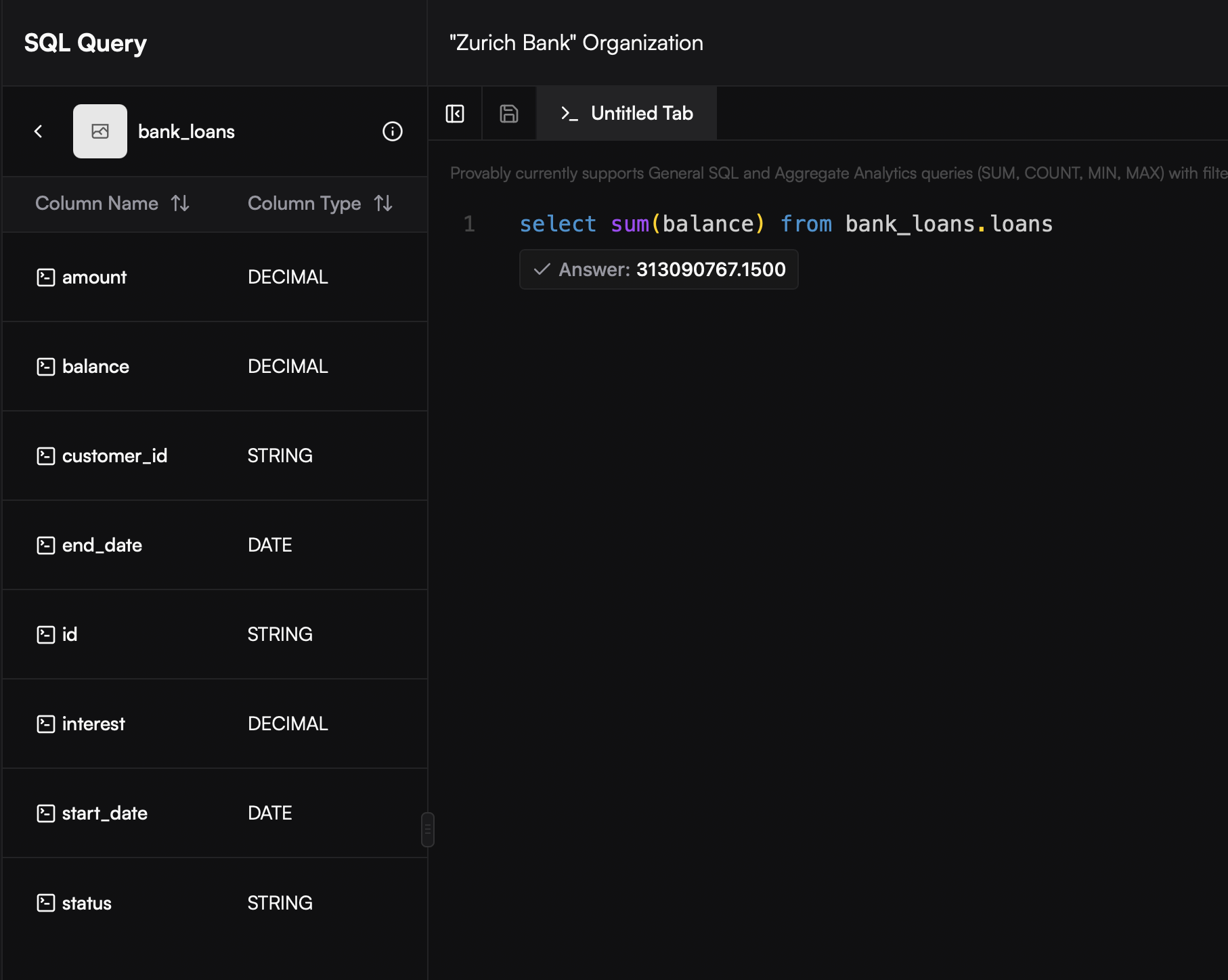
One of the most exciting parts of this release is the new IDE experience.
Users can browse data collections, write SQL queries instantly, and get back either verifiable analytics or raw data, depending on the use case and permissions. This makes Provably V2 feel much closer to a real developer and analyst workflow.
The goal has always been simple: make verifiable databases usable by normal builders. Not just cryptography specialists. Builders, analysts, data teams, and anyone who wants verifiable responses from remote data.
Performance in this version is notably faster.
When a data owner onboards data into Provably, the data is committed and preprocessed upfront. After that, SQL queries can be executed, and proofs are typically returned in the millisecond range, depending on the amount of data in the scope of the query. See more details here.
If the underlying data changes, the data owner can simply run preprocessing again in the platform to refresh the committed state. There is a faster updates feature available via APIs for frequently changing datasets. Contact us if you want to try that before a general release.
Provably V2 is now available with a free tier, making it easier for teams to start experimenting with verifiable data in real products.
The free tier currently supports up to 100k rows per table and up to 10 tables per organization. If your use case needs more than that, reach out and we can enable the right permissions and support for your deployment.
This release is an important step, with paid features and broader enterprise support on the way as the platform continues to expand.
We also expect to launch MCP and CLI support in the near future, making it easier to integrate Provably into agentic workflows. At the same time, we are continuing to expand SQL support, improve update handling, and make onboarding smoother for larger and more dynamic datasets.
Now is the right time to experiment with verifiable data in your own product, whether you are improving privacy, strengthening integrity, or building more trustworthy AI data workflows.
Happy building, and do not hesitate to reach out as you build toward a verifiable future.