We thank Nikolai for the pictures.
And Matteo for the continuous collaboration.
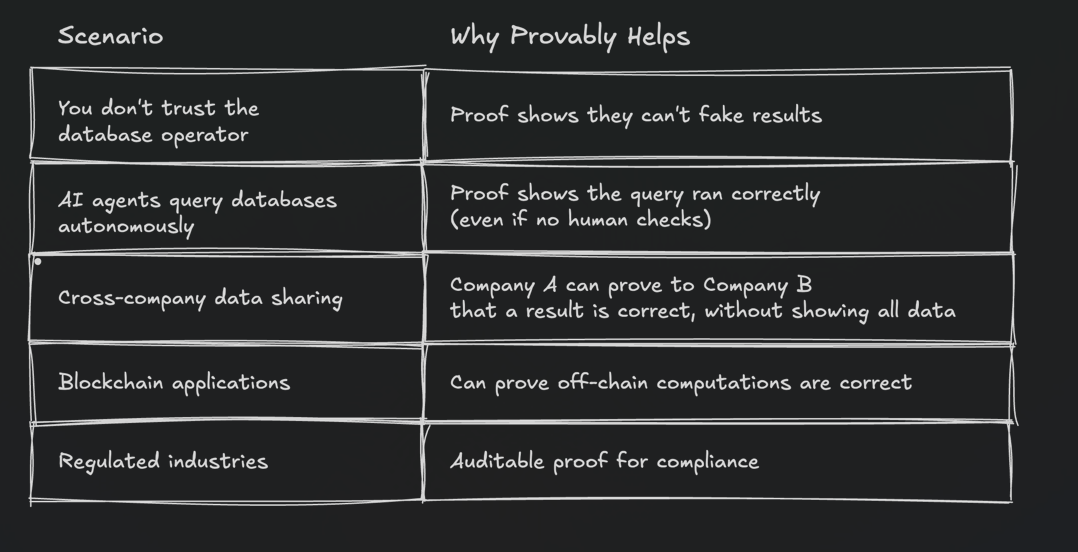
Trust in computing has always been a difficult problem to solve. With time, the typical IT tech stack has grown to a complex system of hardware and software components that often are owned and managed by different actors. This complex system is also often underpinned by a set of trust assumptions that depends on human behaviour rather than rigorous technological machineries. This is true when a user (human or not) needs to query a remote or third-party database. How can the answer be trusted? While it is true that a commercial/legal relationship can maintain a chain of trust, there are multiple scenarios in which the commercial/legal link can quickly become the weakest and slowest link in the chain.
The problem of querying a remote/outsourced database, and trusting its responses, has shaped a decade of research into verifiable databases (VDBs). Specifically, VDBS are systems designed to ensure that query results are not only correct but cryptographically provable. Over the years, two main approaches have defined this space:
(1) systems built from authenticated data structures (ADS), and
(2) systems that use general-purpose cryptographic proof systems (SNARKs).
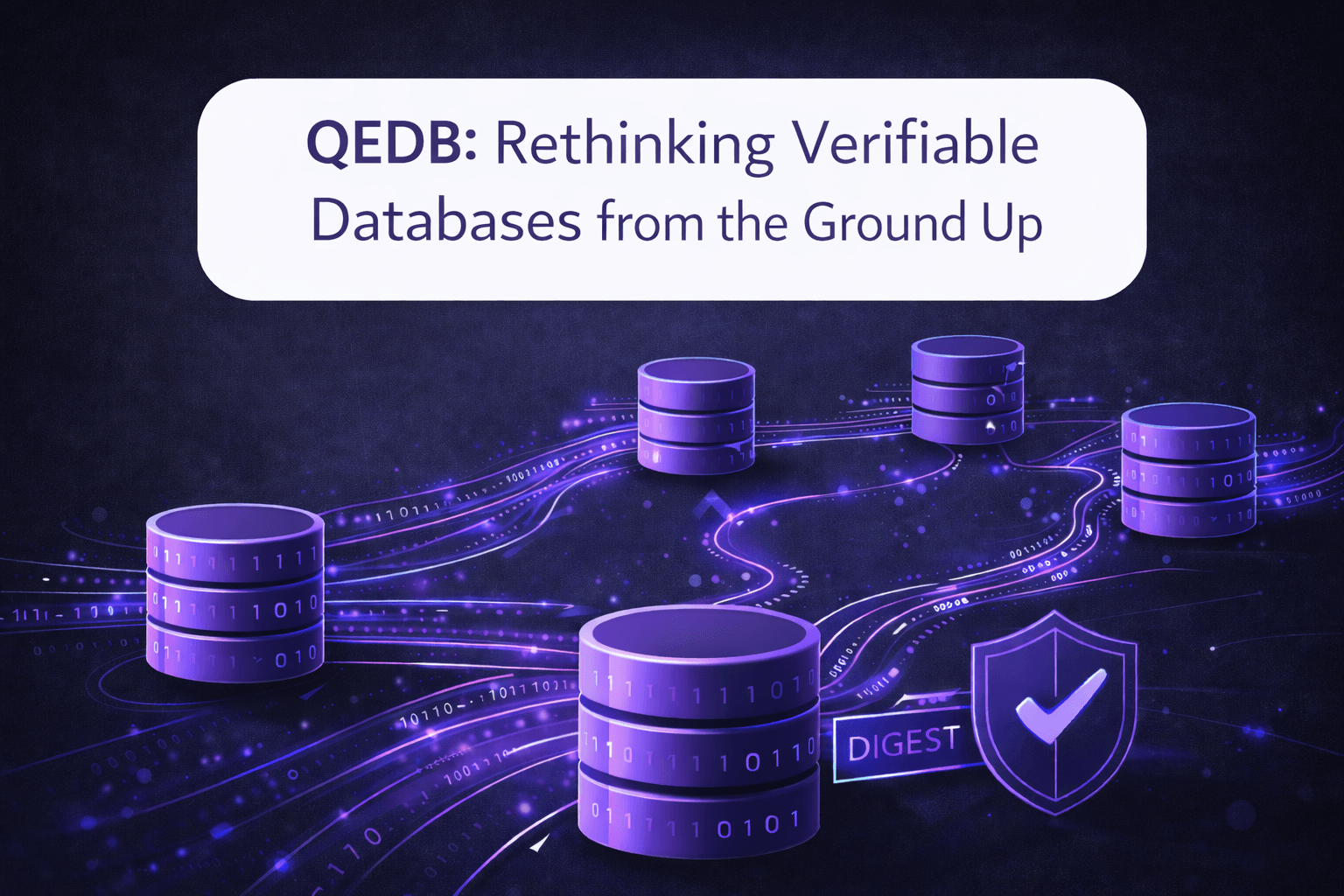
Today’s VDBs are at a crossroads. On one hand, SNARK-based systems can verify arbitrary computations, including SQL queries, but at the cost of complexity and high overhead. On the other, ADS-based designs are lighter and more intuitive but traditionally limited in expressiveness. QEDB, from provably, emerges from the conviction that we can merge the best of both worlds: a return to the ADS roots, but equipping them with a modern algebraic engine.
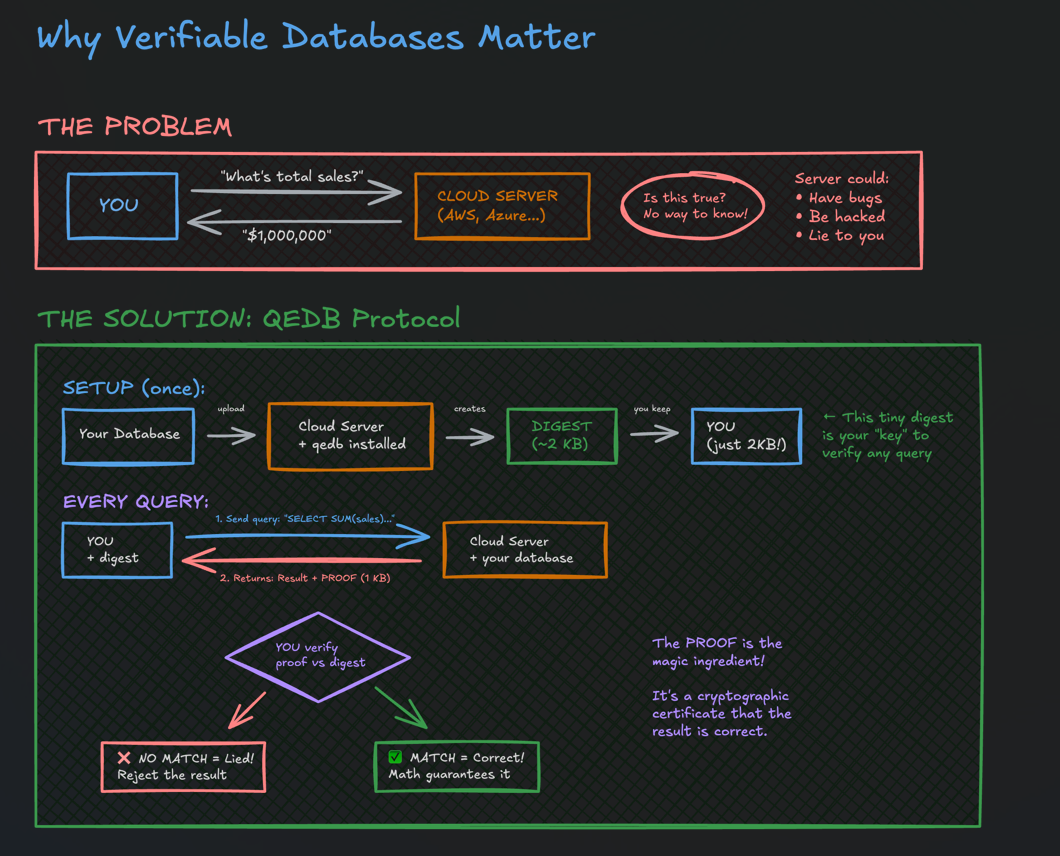
At the conceptual level, all VDBs aim to achieve the same goal: to transform untrusted query answers into verifiable statements. The difference lies in the approaches adopted for generating and verifying the proofs of the statements.
With qedb at provably we decided to take a step back and we asked ourselves:
“what if we stay close to the relational data model itself, and represent it with algebraic commitments instead of generic circuit logic?”
The result is an ad-hoc, algebraically structured proof system that borrows the conceptual clarity of ADS and combines it with the succinctness and composability of modern generic proof systems.
In qedb:
In other words, qedb is not a “SNARK for SQL” but an ADS-based proof system reborn with algebraic structure. It is specialized, expressive, and efficient.
The landscape of verifiable databases is evolving fast. Academic prototypes, such as IntegriDB and PoneglyphDB, and commercial systems like Axiom, Lagrange Labs, and Space and Time, all highlight a growing demand for trustworthy query results. But the design tension remains: between generality and efficiency, between cryptographic abstraction and system-level simplicity. Our philosophy at provably is to resolve that tension through specialization:
Instead of forcing databases to conform to the shape of generic proof systems, we let the proof system grow out of the structure of the database itself.
Verifiable computation started as a problem of proving anything about any function. Verifiable databases refine the challenge: proving statements about structured data. qedb is built on the belief that this difference isn’t cosmetic. The difference should be foundational.
And with the new foundation for VDBS that we are establishing at provably, our vision is to unlock a new set of verifiable applications at scale, from Defi to Blockchains to AI agents to Synthetic Data Generation.

By blending authenticated data structures with modern algebraic commitments, qedb opens a path toward lightweight, expressive, and genuinely practical verifiable databases.
Finally the gap between theory and data-intensive real-world scenarios starts to close.